

Smitten by Art: Armin Strom × Revolution Dual Time GMT Resonance ‘Tremblage’
Limited Edition
Smitten by Art: Armin Strom × Revolution Dual Time GMT Resonance ‘Tremblage’

Summary
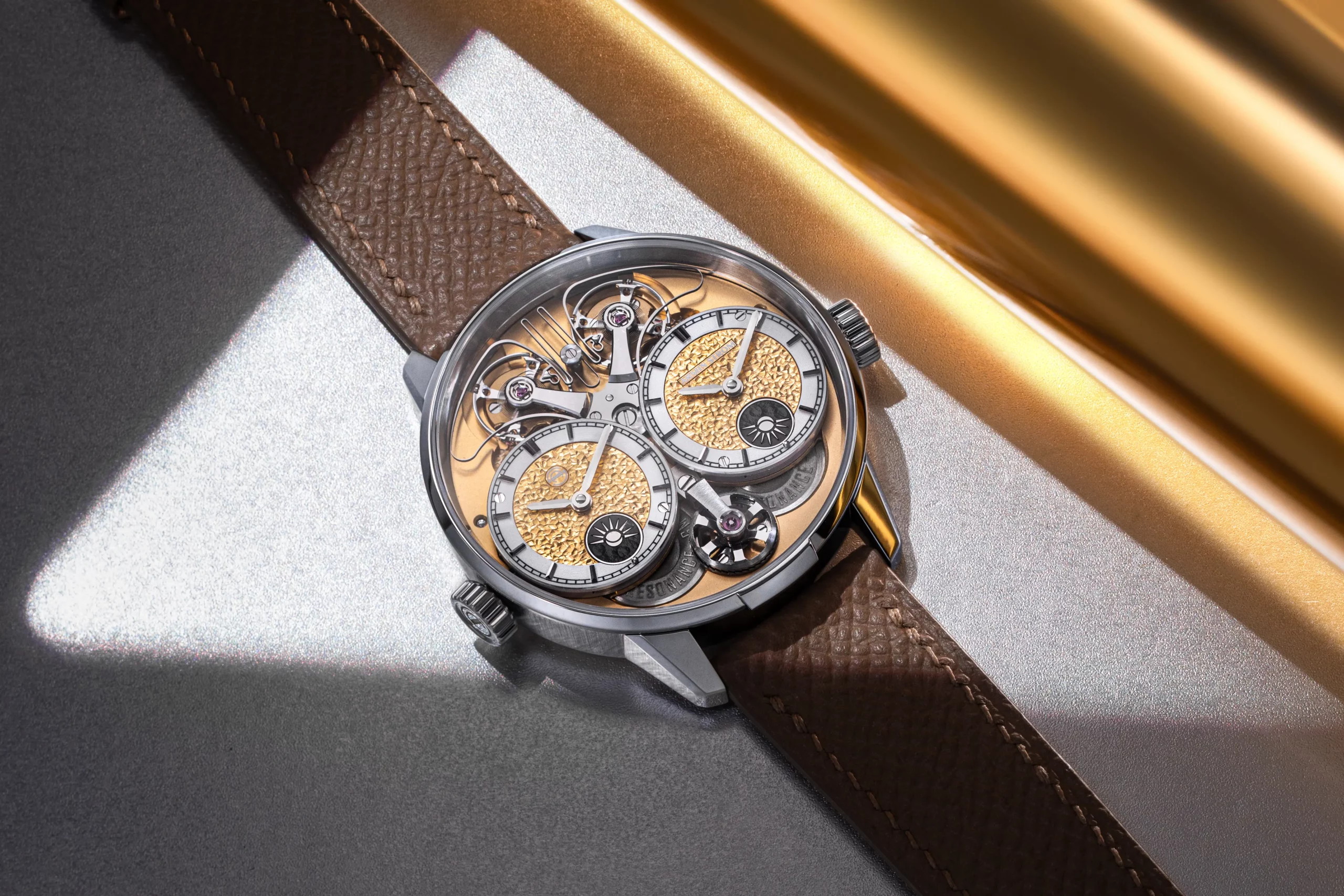
Armin Strom × Revolution Dual Time GMT Resonance ‘Tremblage’ (Image: Revolution ©)
As a testament to our Technical Editor Cheryl Ann Chia’s descriptive brilliance, she explains, “The difference between Armin Strom’s Resonance and that of any other watch featuring this scientific phenomenon, is the difference between in-vitro fertilization and natural occurring pregnancy — one is the product of scientific advancement; the other relies on the beauty of nature and faith.”
What she means is that because of Armin Strom’s patented clutch that connects the studs of both hairsprings placed in opposing directions, it is impossible for them to expand and contract in any other way than in perfect synchronicity. This means that any time one of the balance wheels is adversely affected by shock, for instance, the other balance will compel it back into synchronicity, enabling it to recover much faster than with balance wheels that are otherwise not linked.
The creator of this rather extraordinary breakthrough, Armin Strom’s co-owner and master watchmaker Claude Greisler, states, “The clutch is not meant to force resonance to occur. Rather, it just links two springs through vibration to breathe exactly the same, which means that the balance wheels oscillate at precisely the same rate.”
Chia elaborates, “The genius of his invention is that even though Greisler says that resonance is not ‘forced’ or ‘induced’ by the bridge, the connection between the springs means that resonance must occur between them. Further, by placing the hairsprings in opposing directions, it means that when one of them deforms as a result of positional change, the other one deforms in precisely the opposite direction, causing them to balance each other out.”
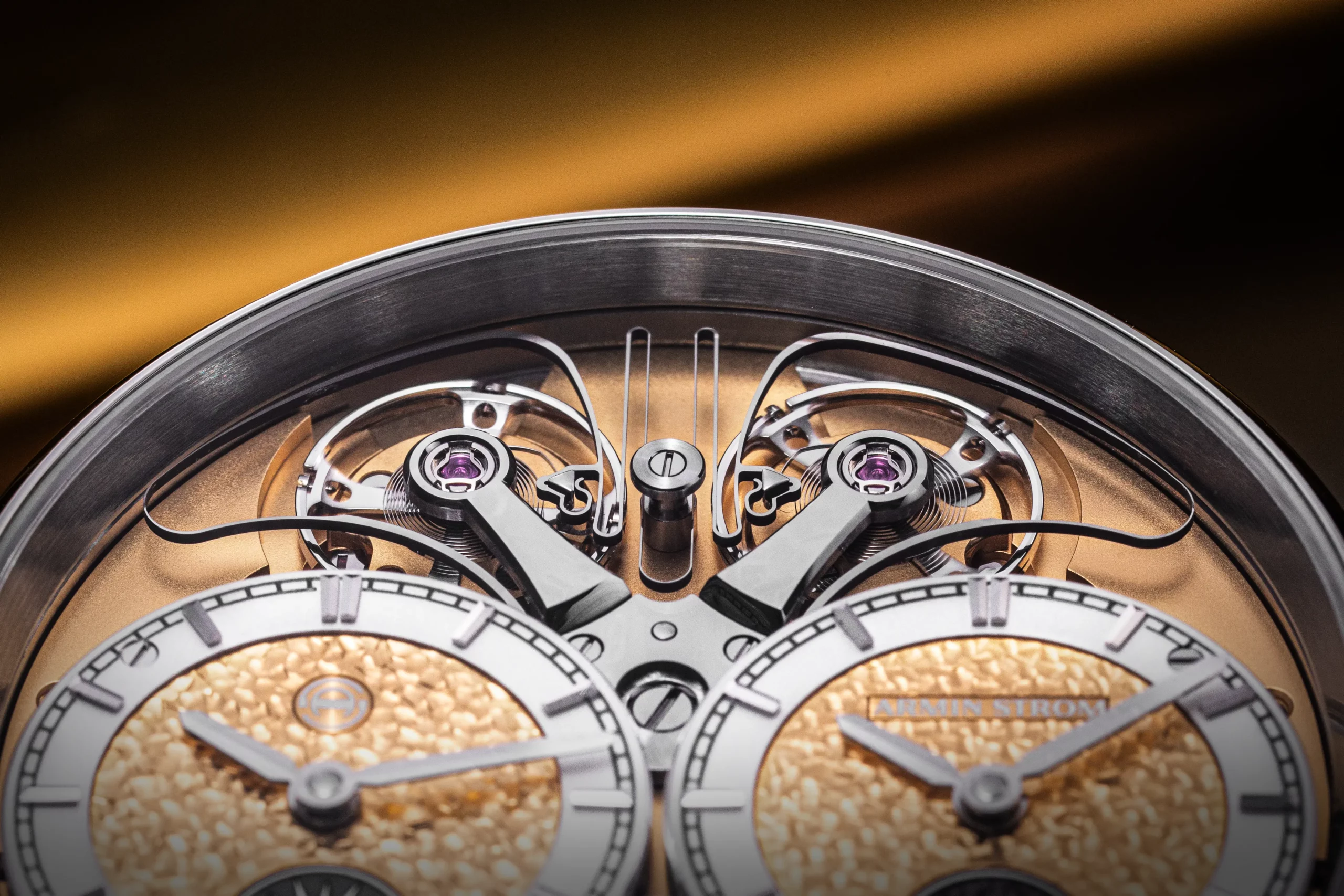
Twin balance wheels connected by Armin Strom’s patented steel clutch spring. (Image: Revolution ©)
Thanks to the technical breakthrough of the clutch, Claude Greisler’s Dual Time GMT Resonance and its predecessor, the Mirrored Force Resonance, represent milestone achievements in modern horology. Learn more about this edition here.
Says watch writer and collector Declan Quinn, “Almost every new independent watchmaker is simply remaking technology from the 17th or 18th century — detent escapements, chain and fusées, etc. What I really respect about Armin Strom’s Resonance watch is that it takes the principal discovered by Christiaan Huygens, advanced by Antide Janvier and Abraham-Louis Breguet, and adds a very real, tangible new technology that is also empirically proven to enable resonance to occur. The watch has already been tested and proven by the Swiss Center for Electronics and Microtechnology (CSEM), which is also the scientific laboratory that created silicon technology for the Swiss watch industry.”

Armin Strom co-owners Serge Michel and Claude Greisler
As such, when planning for Revolution’s 20th anniversary, we knew that we had to collaborate with Armin Strom owners, Serge Michel and Claude Greisler, to create a version of this massively groundbreaking timepiece.
When we initially approached Michel and Greisler a few years ago, we had one concern — the 43mm diameter of the Mirrored Force Resonance timepiece. That was when they told us they were working on a 39mm by 9.05mm version of the watch that would feature an additional hour and minute dial to allow for dual time indication.
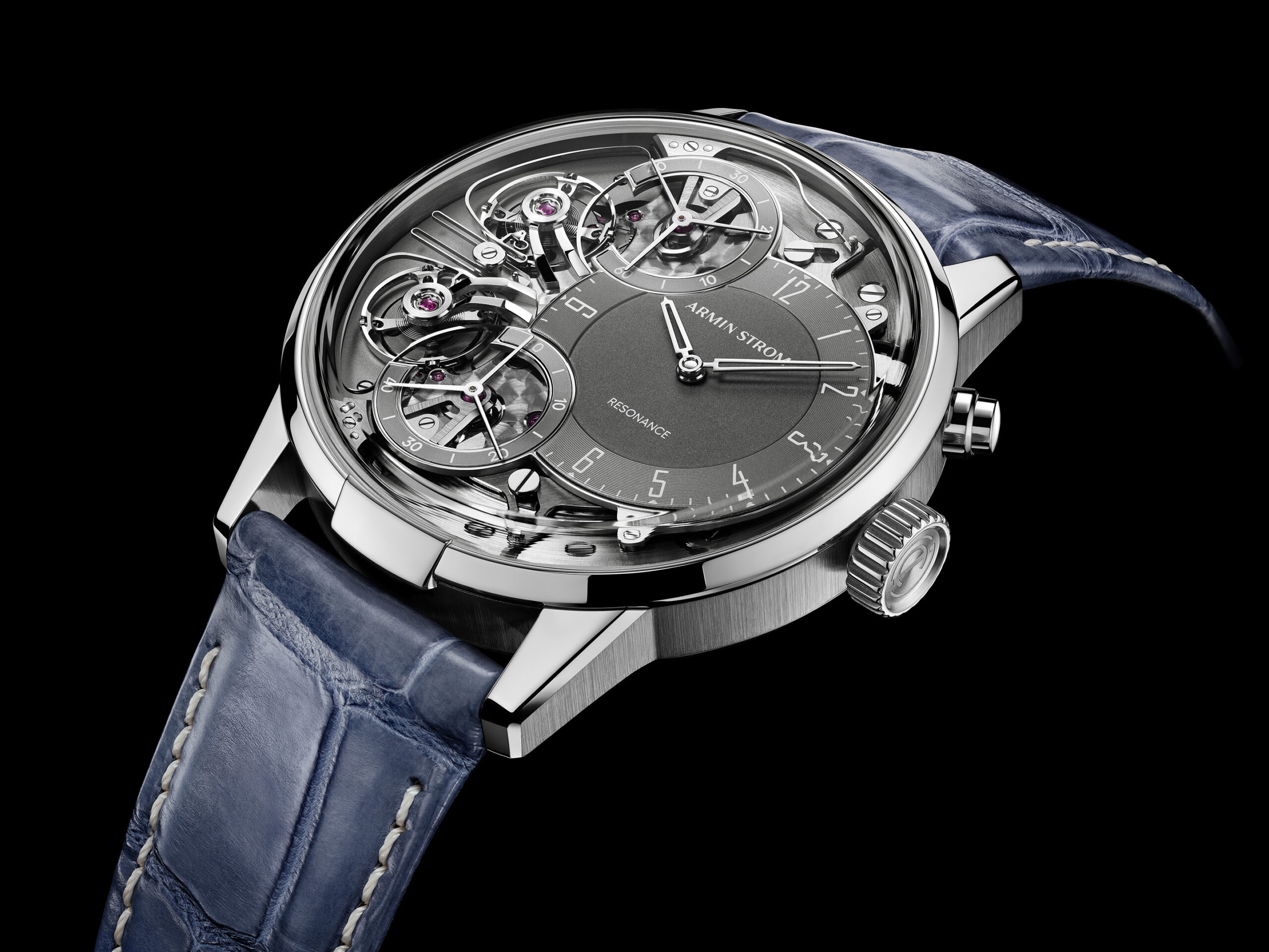
Armin Strom Mirrored Force Resonance 2.0
Greisler explains, “The Dual Time GMT Resonance represents three years of work. We had to completely redesign everything from the gear train up. We decided to place both of the balance wheels at the top of the dial, next to each other, to create a really beautiful sense of visual harmony. The entire top of the watch is all about the balances beating together and the expansion of the clutch spring connecting them. It is, to me, kinetic art.”
You can learn all about the Armin Strom Dual Time GMT Resonance, launched last year at Geneva Watch Days, here:
We were thrilled, but the question then became: how do we distinguish our watch from their original first edition when it was already so damnably good?
Artisanship at Armin Strom
The answer came when I met up with my friend and watch-collecting guru Jack Wong. On his wrist was his Mirrored Force Resonance. As I examined his watch, I realized that his balance bridges had been finished in some of the most impressive tremblage I’d seen. For those of you not familiar with this, tremblage is a micro-etched pattern on a metal that creates the optical effect that the surface is “trembling.” It can, of course, be stamped and even created by rubbing the surface with a coarse foam known as a “mousse.” But in the most refined instances, it is the result of thousands of minute, gently overlapping incisions engraved with a burin and accomplished entirely by the hand of a master craftsman of the highest order. This was exactly what I was looking at.
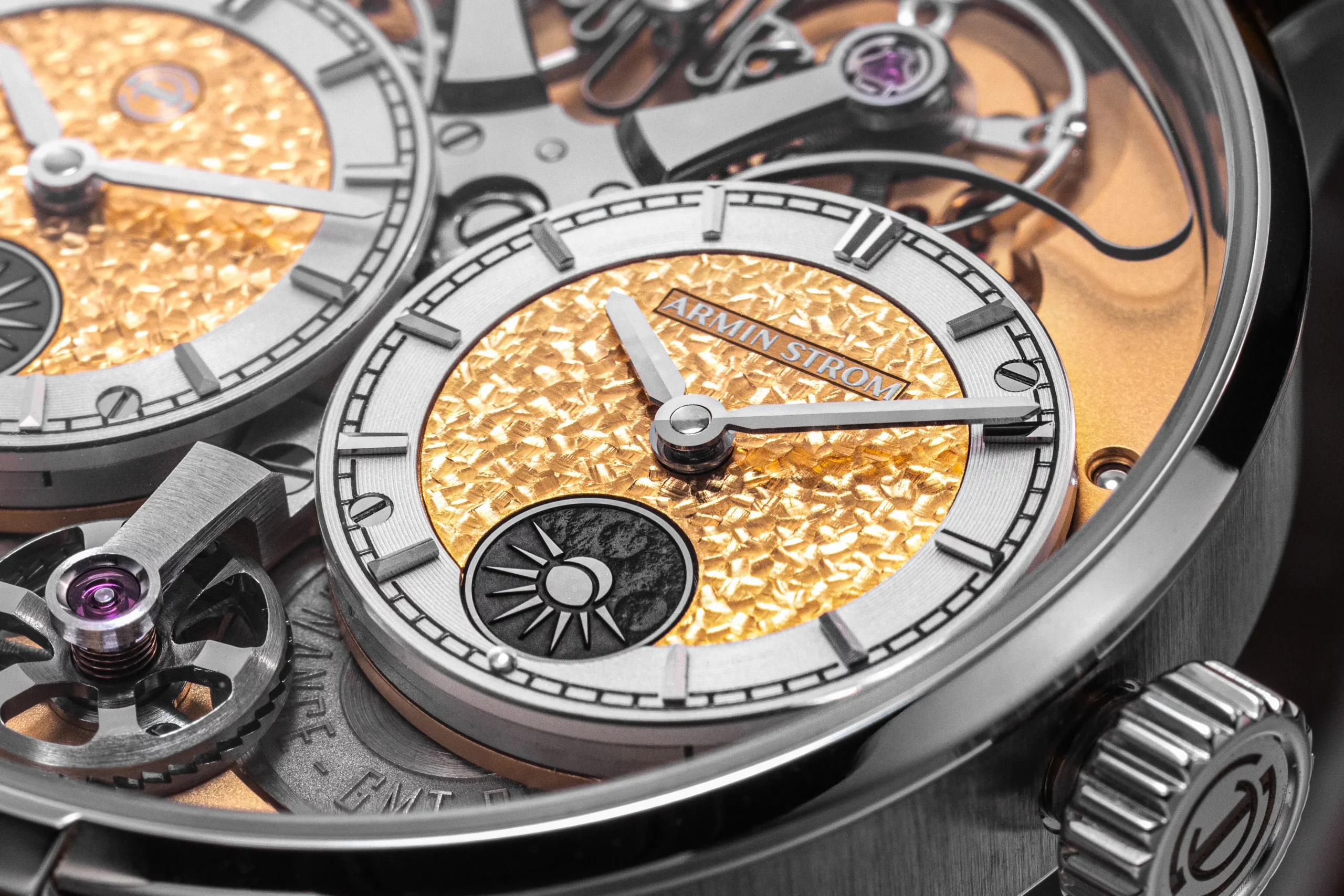
Close-up of the right-hand tremblage dial on the Armin Strom × Revolution Dual Time GMT Resonance (Image: Revolution ©)
When I asked Serge about this, he smiled and explained that the woman who had created this tremblage was their resident expert in engraving and also a master watchmaker. Her name is Juliane Gfeller. She had grown up in Glashütte in the last years of the East German republic before coming to Switzerland to work with none other than the brand’s visionary founder, Mister Armin Strom. She specialized in the stunning skeletonized timepieces that Strom was famed for. Today, she works on the brand’s most complicated watches, but Michel felt that she would be enthusiastic about working on a watch where she could express her full creativity and artistic ability. After one meeting with Juliane, I knew she was someone very special, capable not only of the highest level of technical watchmaking, but also mastery of the decorative arts.

Master artisan Juliane Gfeller hand-engraving a watch component with traditional tools.

Juliane Gfeller carefully inspecting a case element under magnification in the Armin Strom atelier.
We decided to use untreated solid gold for the two dials of our watch to provide Juliane the very best canvas for expression. When she asked what pattern she should make on these dials, I replied that I wanted to leave it to her. Further, I wished that she would feel free to create unique patterns on every one of the five timepieces that comprises this very small series of artistic and horological treasures. She willingly agreed — on the condition that she wouldn’t be rushed during the making of these dials, so that she could spend as much time on them as she wanted. I have to thank Serge Michel for agreeing to this condition as well.
“These watches are not so much a commercial project as something we wanted to do to honor Juliane and her history with Armin Strom,” he shares. “So yes, I agreed that she can take her time to make these hand-engraved solid gold dials to the highest level of her ability.”
As Juliane took her time to craft these magnificent one-of-a-kind dials, it gave me an opportunity to learn more about Claude Greisler’s fascination with resonance. He brought me to his office in the Armin Strom manufacture and dug out a box filled with experimental parts. One thing I immediately noticed was an early prototype of a clutch that was made entirely from silicon.

3D rendering of Armin Strom’s patented Resonance Clutch Spring mechanism, showing dual balance wheels in resonance (3D rendering demo from Armin Strom YouTube video “ARMIN STROM patented Resonance Clutch Spring,” © Armin Strom).
When I asked about this then, Greisler replied without hesitation, “Yes, we tried the clutch in every conceivable material, but in the end, we chose steel because it transmitted the vibrations between the springs most perfectly. On top of that, I like the idea that 100 years from now, a watchmaker will still be able to repair what we made with the materials that exist. With silicon, I am not so sure.”
Resonance in Watchmaking
It turns out that Greisler’s fascination with resonance is really part of his love for marine chronometers and the incredible advancement in precision watchmaking that came from mankind’s search for timepieces accurate enough to tell longitude at sea. It always amuses me to think of Claude engaged in deep thought about the history of chronometry as he ascends the mountains in his favorite pastime of alpine exploration.
He explains, “Back in the 16th century, you had the major seafaring nations, Spain, Portugal, England and France, warring for dominion over the oceans. It was clear there was a massive competition to expand their empires. But what all of them were missing was that piece of technology that would allow them to safely navigate the seas. And that was what would be called a ‘marine chronometer,’ a shipboard clock that was so accurate that it would only deviate a few seconds per day.
“Sailors could determine latitude based on the position of the stars relative to the horizon. But longitude at sea had to be determined with a clock set to the time at a known reference point, such as Greenwich, and comparing it to the local time, which was determined by solar observations.”
The cost of inaccuracy was massive. On the Equator, a deviation of approximately 4.5 seconds corresponds to an error of around one nautical mile. With this in mind, you can understand how between 1550 and 1650, one of five ships perished at sea.
It is Greisler’s theory that Christiaan Huygens, the Dutch watchmaker, engineer, physicist and mathematician considered the greatest scientific mind between the death of Galileo and the birth of Isaac Newton, was interested in resonance, which he originally called synchronization, in order to solve the longitude challenge. Huygens first identified resonance when lying in bed. He noticed that two pendulum clocks attached to the same wooden beam began to oscillate in synchronicity even when one was stopped and restarted. In the 1700s, the watchmaker Antide Janvier made the first clocks with double pendulums that oscillated in resonance. Then Abraham-Louis Breguet went on to also make double pendulum clocks and three resonance pocket watches with double balance wheels. Greisler believes that all of these efforts were focused around harnessing the unique power of resonance.

Portrait of Christiaan Huygens, 17th-century Dutch mathematician, physicist, and horologist (Image: Public Domain)
Now, there are several theories on how resonance occurs. The first is that resonance is an acoustic phenomenon. The second is that energy is transmitted and received through vibrations. It is Greisler’s belief that resonance is a vibrational phenomenon. His act of genius was not to create a watch where he would place two oscillators together with the hope that they would enter into Huygens’ synchronicity, but to attach the two hairsprings of these balance using his patented clutch.
When looking at any of Armin Strom’s watches, you can see that the balance wheels oscillate in precise anti-phase, meaning in opposing directions, while their hairsprings breathe — expand and contract — at precisely the same rate. The Armin Strom Dual Time GMT Resonance, which forms the base of our collaboration, can only function with the balance wheels in resonance. But the clutch also acts as a kind of brilliant anti-shock device.

Front view of the Dual Time GMT Resonance calibre, displaying twin balances and gear train.

Reverse side of the calibre with intricate bridges and gearwork finishing.
Says Greisler in an interview with Frank Geelen of Monochrome, “All resonance watches rely on what scientists call shared modes of motion. The key difference with our approach lies in the resilience of our oscillating bridge and its ability to consistently maintain a resonance state between two balance wheels when they’re impacted by gravity, wrist movement or shocks — which, in other methods, would result in oscillation rate deviations. Our patented clutch spring, which took three years to develop, proactively prevents such oscillation rate deviations rather than just remediating them… Where other methods will remediate that deviation over time by exerting influence to lure the balances back into a state of resonance, the inherent resilience of our method actively prevents such deviations in the first place.”
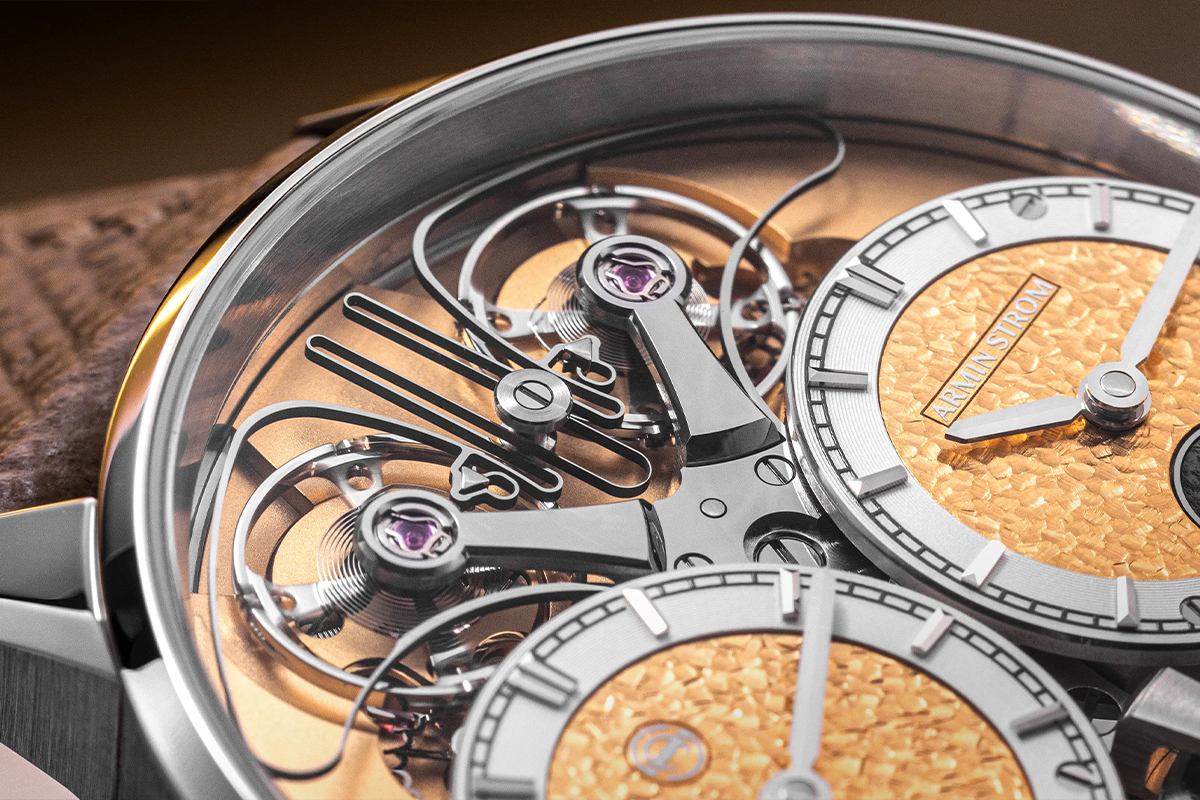
There is even a cap that sits over the clutch, affectionately nicknamed “the mushroom” by Greisler, that keeps the spring in place even in the case of violent shocks.

Close-up of Armin Strom’s resonance mechanism with the central protective cap, nicknamed “the mushroom,” securing the resonance clutch spring between two balance wheels (Image: Revolution ©)
Armin Strom × Revolution Dual Time GMT Resonance ‘Tremblage’: A Testament to the Best

The 39mm Armin Strom × Revolution Dual Time GMT Resonance ‘Tremblage’ on the wrist, showing its balanced twin-dial layout (Image: Revolution ©)
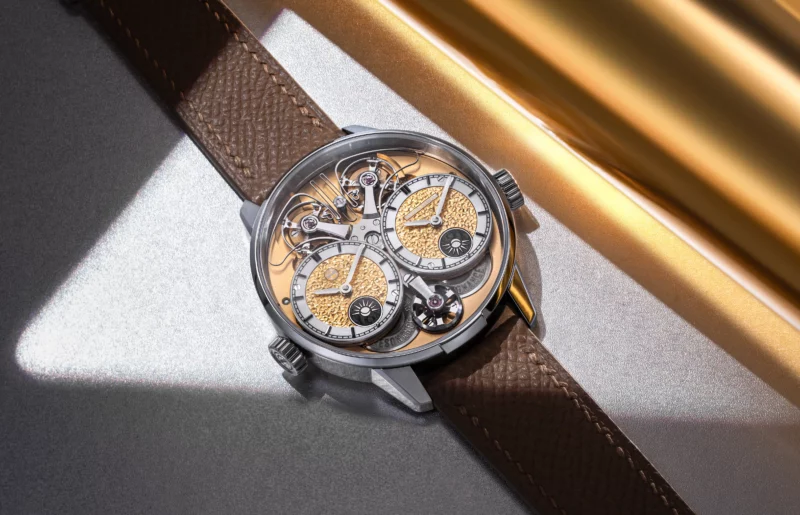
The unique advantages of Armin Strom’s Resonance watch are impressive. But when I set eyes on the first prototype of our collaborative timepiece, I was utterly blown away. We had selected a steel case and a gold “frosted” baseplate to create a decidedly 18th century aesthetic for the watch. We could only imagine the type of timepieces Claude Greisler would have created had he lived in this era. But the most attractive features of the watch are the two solid gold hand-engraved tremblage dials created by Juliane Gfeller, which are absolutely stunning — see the Dual Time GMT Resonance ‘Tremblage’ here.
Gfeller points out that the hand finishing on this timepiece extends also to the spéculaire, or black polishing, on the balance bridges, clutch as well as the bridge for the ratchet wheel linking the two barrels. Incidentally, this ratchet was placed on the dial side by Greisler to create greater visual balance on the front of the watch and even finetuned by him to have the perfect feel and sound. There are also two stunning marine-chronometer-style bridges on the back of the movement for each of the two third wheels, featuring handmade sharp inner angles. Gfeller explains, “Our timepieces are some of the best finished in the industry, and I hope that this is well expressed by our collaboration.”
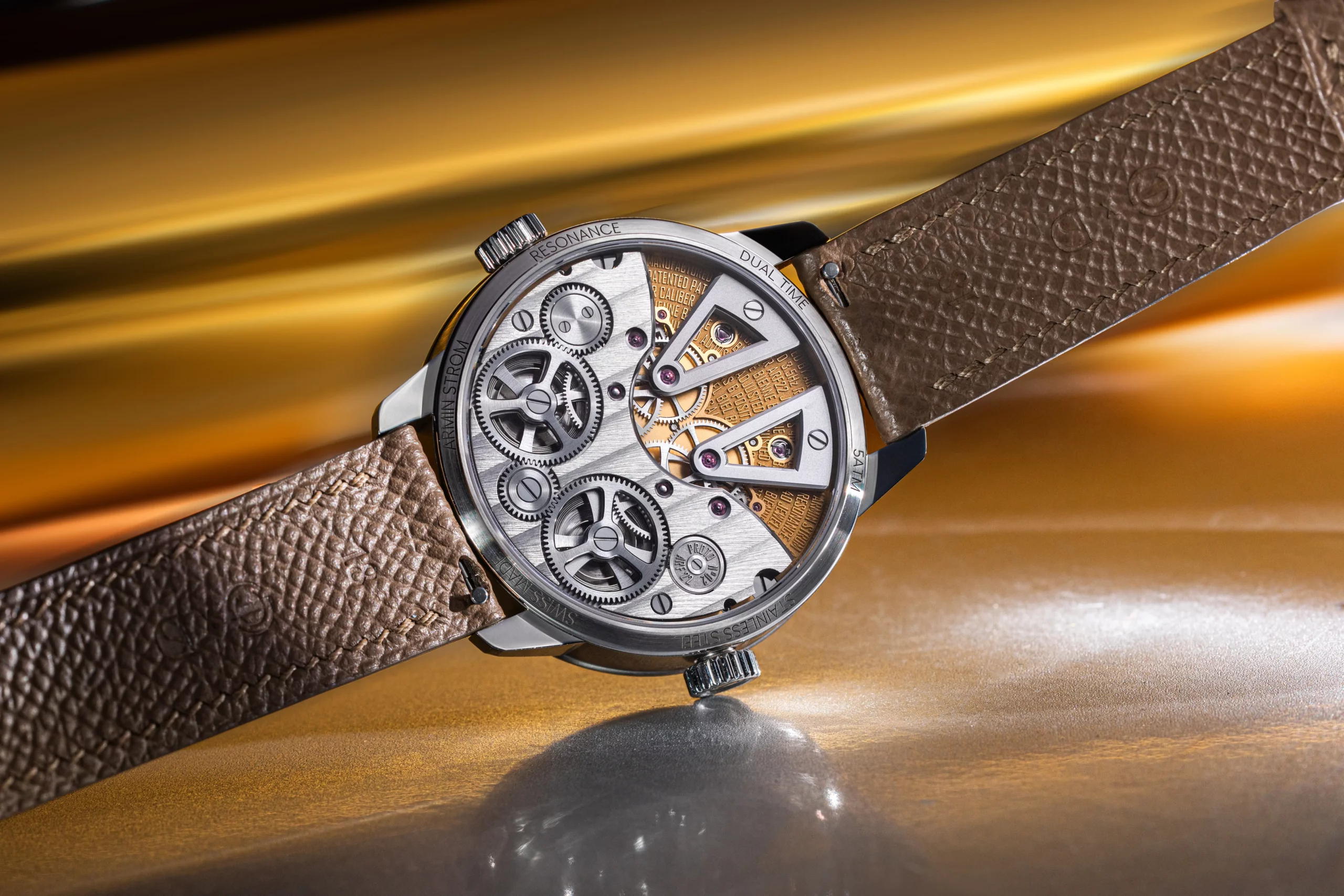
Caseback view of the Armin Strom × Revolution Dual Time GMT Resonance ‘Tremblage’, showcasing the twin mainspring barrels, gear train, and two marine-chronometer-style bridges with sharp inner angles. (Image: Revolution ©)
As an amusing aside, we had recently entered the question, “What will be the value of beautifully handmade objects in the future?” into several AI search engines. We got similar responses from all of them: without a doubt, the value of human skill and craft, such as that expressed by Juliane Gfeller, will be greater than that of gold.
It thus gives me immense pleasure to introduce the Armin Strom × Revolution Dual Time GMT Resonance “Tremblage,” created in a very small series of five unique and numbered pieces and priced just marginally above Armin Strom’s 2025 “Manufacture Edition Black” at 100,000 Swiss francs. This watch symbolizes to me the perfect combination of groundbreaking, historically significant watchmaking with breathtaking artisanship.

Armin Strom × Revolution Dual Time GMT Resonance ‘Tremblage’ (Image: Revolution ©)
Tech Specs: Armin Strom × Revolution Dual Time GMT Resonance “Tremblage”
Movement: Manual winding Caliber ARF22, with frost gold grenage finishing on baseplate; 42-hour power reserve
Case: 39mm × 9.05mm; stainless steel; water resistant to 50m
Dial: Each dial is beautifully finished by hand in tremblage, a micro-etched pattern on a metal that creates the optical effect that the surface is “trembling.”
Price: CHF 100,000 (excl. VAT)
Availability: Limited edition of five numbered pieces
Armin Strom

You may also like
limited
Armin Strom × Revolution Dual Time GMT Resonance ‘Tremblage’
Sep 2, 2025
limited
Armin Strom × Revolution Dual Time GMT Resonance ‘Tremblage’
Sep 2, 2025
Reviews
A Closer Look: Armin Strom Dual Time GMT Resonance Manufacture Black Edition
Aug 18, 2025
Reviews
A Closer Look: Armin Strom Dual Time GMT Resonance Manufacture Black Edition
Aug 18, 2025
Watches & Wonders 2025: All The First-Time Exhibitors
Apr 6, 2025
Watches & Wonders 2025: All The First-Time Exhibitors
Apr 6, 2025