


Vacheron Constantin’s La Quête du Temps: A Mechanical Odyssey
News
Vacheron Constantin’s La Quête du Temps: A Mechanical Odyssey

Summary
It begins not with a tick, but with a gesture. Beneath a vast glass dome painted with constellations that filled the sky on September 17, 1755, a bronze figure awakens. The Astronomer raises an arm to the heavens, traces the curve of the Moon, then slowly points to the hours and minutes suspended in the air. Music swells — composed by Woodkid, mechanical yet lyrical — and for a moment, the entire mechanism feels alive.
This is La Quête du Temps, Vacheron Constantin’s extraordinary creation for its 270th anniversary. Not a watch. Not simply a clock. But something beyond category: an object that fuses philosophy, mechanics and art in a single, towering presence.

The Astronomer awakens beneath a glass dome of constellations, tracing celestial paths with gestures that blur the line between mechanism and ritual.
The Continuity of a Quest
Marking 270 years is no small milestone, and Vacheron Constantin has chosen to honor it with more than a commemorative watch. La Quête du Temps — the Quest for Time — is more than a name. It captures Vacheron Constantin’s centuries-long pursuit of beauty, knowledge and invention. This clock is not just an anniversary piece; it is a declaration, distilling nearly three centuries of savoir-faire into a single creation that dares to ask what time itself can mean.
Seven years in the making, standing more than a meter tall and built from 6,293 components, it carries within it 23 complications and 15 new patents. Yet to stand before it is not to count numbers but to feel scale: a monument to time itself. As CEO Laurent Perves reflects, the project was “the culmination of seven years of work … an expression of mécanique d’art that brings together past and future in an unprecedented statement of culture and intention.”

Beneath its automaton, a symphony of gears and retrograde displays — 6,293 components orchestrating 23 complications in monumental scale.
The idea began with a question: what if an automaton could be more than decoration? What if, instead of charming animation, it shouldered the responsibility of telling the time? As Christian Selmoni, Director of Style & Heritage, puts it, the Maison wanted to “surpass ourselves … and decided that we would have a timekeeping mechanism with an additional complication: an automaton that would indicate the hours and minutes.” That single choice redefined what was possible, opening a path that demanded new engineering, new artistry and an unusual degree of perseverance.
Inside the manufacture, designers and watchmakers worked side by side, but the challenge soon grew too vast to contain. The project spilled outward, gathering the finest collaborators in their fields. L’Epée 1839 engineered the monumental clockwork, ensuring that thousands of parts would move with the delicacy of a wristwatch caliber, only on a scale measured in kilos. François Junod, master automatier, sculpted and animated the Astronomer itself. “In a lifetime of creating automata,” Selmoni recalls Junod saying that “this was by far the most difficult project he had ever undertaken.”
Music became another complication. Woodkid’s score is written into the clock as surely as any gear or cam, lifting the automaton’s gestures into choreography. And from the Geneva Observatory came the celestial map itself, painted inside the dome as it appeared on the morning of Vacheron Constantin’s founding. By fixing that moment in the heavens, the Maison has inscribed its own origins into a mechanism of today.
A Monument of Timekeeping Innovations
Beyond beauty, the clock is also a symbol of innovation. A mechanical “memory” transfers time from the caliber to the automaton, allowing the figure to keep time with 144 distinct movements. The tourbillon, oversized and luminous, commands the dial. Retrograde displays sweep back and forth — for hours, minutes, moonphase, date and power reserve — each one a reminder of Vacheron Constantin’s signatures, now amplified to monumental scale.

At the base, a universe in miniature: lapis lazuli skies inlaid with gemstones mark the Solar System, each planet rendered as a jewel.
And yet, for all its intricacy, the clock never loses a sense of play. “At every stage,” Selmoni recalls, “we wanted to go further … but we never lost the element of fantasy.” That balance, a rigor paired with wonder, is what gives La Quête du Temps its heartbeat.
At the summit of the clock, the Astronomer presides: androgynous, poised, part philosopher, part dancer. Cast in bronze, gilded in 3N yellow gold, its body is traced with constellations and set with diamonds marking the principal stars. When it moves, the effect is uncanny as this being of metal is animated with surprising grace.
Its choreography unfolds in three acts. First, a melodic signal stirs the figure awake; it glances around, gestures toward the symbols of day and night at its feet, then traces the Moon’s arc across the sky. In the second act, its arms lift towards the constellations above, following them with its gaze as Woodkid’s composition fills the air. In the third, the Astronomer points directly to the suspended scales of hours and minutes, synchronized with the clock’s own display. Each performance lasts barely 90 seconds, but the impression lingers — less a demonstration than a ritual, a reminder that time is both mechanical and human.
Beneath this figure lies the astronomical heart of the piece. Two dials, transparent and layered, reveal complications that would themselves be the pinnacle of any timepiece: a perpetual calendar, sunrise and sunset times, sidereal time, a 15-day power reserve and an immense tourbillon at 12 o’clock. Retrograde hands sweep dramatically back across their scales for hours, minutes, date, moonphase and power reserve. Turn the clock around, and the reverse shows a rotating vault of the northern sky, calibrated precisely to Geneva on September 17, 1755. Astronomers confirmed that on that very morning, Venus, Mars, Jupiter and Saturn aligned in rare coincidence — a cosmic event now preserved under glass.
Even the base carries a universe within it. A plinth of lapis lazuli inlaid with hardstone marquetry depicts the Solar System, each planet rendered in a gem: Earth in azurite, Mars in red jasper, Jupiter in agate. Their names are spelled out in mother-of-pearl, encircled by stars. Above, rock crystal panels cloak the mechanism in light, so that the vast engine seems to float, almost transparent, despite its mass.

On its reverse, the northern sky of 1755 turns in perpetual motion, preserving the heavens of Vacheron Constantin’s founding morning.
Vacheron’s Exceptionalism on Display
Making such an object beautiful was as great a challenge as making it functional. Selmoni recalls the struggle to source rock crystal of sufficient size and purity, a search that took two years. Once obtained, the material had to be cut, polished and shaped by hand before it could be set into place — each piece fragile, unforgiving. Then came the dome itself: a hemisphere of glass, painted freehand on its inner surface with constellations in mirror image, without guide or template. The artist worked bent over the curve for weeks, painting backwards and upside-down, until the heavens emerged.
The result is paradoxical. La Quête du Temps commands any room it occupies, yet it also seems to vanish into light and air, every surface worked to radiance. Diamonds sparkle from the Astronomer’s gilded body. Guilloché spreads like sunrays from enameled rings. Gold appliqués of the zodiac gleam against crystal. Nothing has been left plain, because in Vacheron Constantin’s philosophy, finishing is not embellishment, it is central.

And yet this monumental work is not destined for a collector’s vault. Instead, it will take its place in the Louvre from September 17 to November 12, 2025, the sole contemporary piece in the Mécaniques d’Art exhibition. There it will stand alongside 10 historic marvels: Renaissance skull-shaped clocks, fragments of Egyptian water clocks and the Pendule La Création du Monde once presented to Louis XV. In that context, La Quête du Temps is framed not as a novelty but as part of a continuum and a reminder that horology has always been a crossroads of science, art and culture.
For Selmoni, that lineage was essential: “The Age of Enlightenment saw a tremendous surge of interest in devices of unprecedented mechanical sophistication that were also beautifully executed. Choosing to create a human figure was a philosophical decision, in keeping with that spirit.”
The project was not without strain. “Everything was a challenge,” Selmoni admits, from engineering the 158 cams that guide the automaton’s 144 gestures, to inventing new music-box mechanisms capable of playing two different melodies. But in that difficulty lay the point: to push beyond the known limits of horology. What carried the team forward, he says, was joy. “At every stage, the key was to ask: can we go further? Can we make it better? And we never lost the playfulness.”
-

- Front view of Vacheron Constantin’s La Quête du Temps, showing the Astronomer automaton under the glass dome and the main astronomical displays.
-

- Back view of La Quête du Temps, revealing the Astronomer automaton and the mechanical movement visible through the rear.
That is what animates the clock more than gears or springs: a shared human adventure. As Perves observes, “This creation is not just about showcasing what we can do mechanically. It is about asking questions: what is time, how do we perceive it, how do we connect with it emotionally?”
When the exhibition closes, the Astronomer will fall still, its music silent. But the story will remain: of a Maison that dared the unprecedented, not because it was easy, but because it believed that progress demands it. In François Constantin’s words of 1819: “Do better if possible, and that is always possible.”
La Quête du Temps embodies that creed. It does not tame time, nor explain it. Instead, it captures the fascination that drives us to measure, to imagine, to dream. In the Astronomer’s outstretched hand, we glimpse not only the march of planets and stars, but also the centuries of human ambition that made such a creation possible.
Vacheron Constantin
You may also like
News
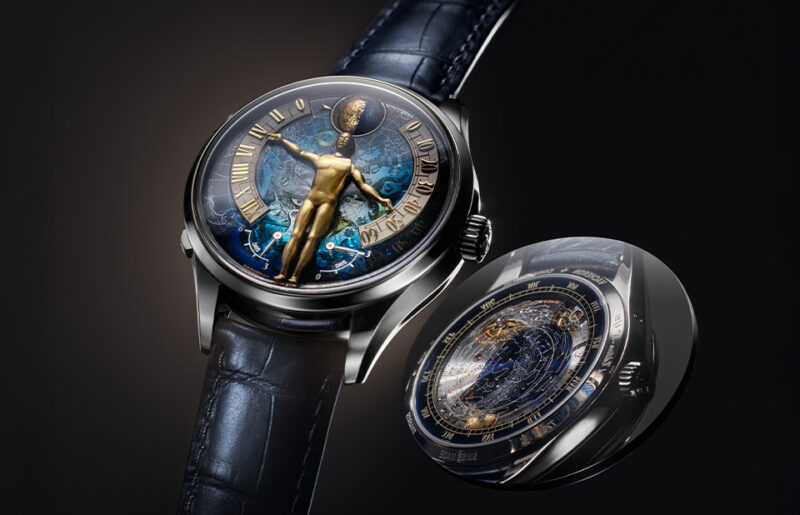
Vacheron Constantin 270th anniversary: Métiers d’Art Tribute to the Quest of Time
Sep 16, 2025
News
Vacheron Constantin 270th anniversary: Métiers d’Art Tribute to the Quest of Time
Sep 16, 2025

News
Vacheron Constantin Unveils A Full Pink Gold Overseas Perpetual Calendar Ultra-Thin Ahead Of Its 270th Anniversary
Aug 26, 2025
News
Vacheron Constantin Unveils A Full Pink Gold Overseas Perpetual Calendar Ultra-Thin Ahead Of Its 270th Anniversary
Aug 26, 2025
News
These Are The Most Iconic Singapore-Exclusive Timepieces Over The Years, And Then Some
Aug 8, 2025
News
These Are The Most Iconic Singapore-Exclusive Timepieces Over The Years, And Then Some
Aug 8, 2025